
Choosing the right drone for farm security is about balancing flight time, stability, and ease of use. You need a device that can handle open fields while ensuring it gets back home safely if the battery runs low. The best models here provide strong GPS connections and reliable return-to-home functions.
Best overall: Holy Stone HS175D. It includes GPS auto-return for safety and a 46-minute flight time, making it a reliable choice for monitoring property boundaries without needing a complex setup.
Best for wind stability: Bwine F7GIM. This drone features a 3-axis gimbal and high-precision sensors that improve stability for clearer footage in open, breezy farm environments.
Best for simple controls: GPS 4K Screen Drone. The remote includes a built-in 4.5-inch screen, allowing you to see your farm feed immediately without needing to connect a separate smartphone.
This guide is for property owners who want a straightforward, dependable way to survey their land from the air.
How We Picked
We compared 48 different drone listings to identify the best options for farm security. Our selection focused on models that explicitly state GPS-assisted auto-return features, as this is critical for preventing loss during long-range property patrols. We prioritized drones that provide clear flight time specifications, camera stabilization, and integrated controllers to ensure the hardware meets daily monitoring needs. Models that lacked clear safety documentation or essential positioning sensors were excluded from our final list.
All 10 products side by side — scroll sideways to see every column.
| Best Choice | ||||||||||
| Preview |  |  |  |  |  |  |  |  |  | 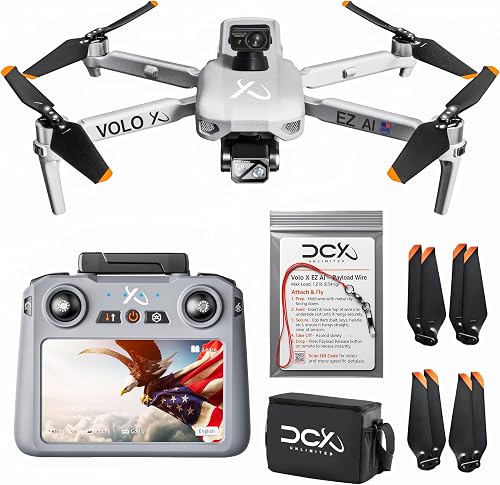 |
|---|---|---|---|---|---|---|---|---|---|---|
| Product | Holy Stone HS175D | Holy Stone HS600D | GPS 4K Screen Drone | Ruko 4K Camera Drone | Bwine F7GIM | YIKKEON 3-Axis Gimbal | Oddire GPS Drone | N11 Pro GPS Drone | 4K FPV Touchscreen Drone | DCX Volo X |
| Brand | Holy Stone | Holy Stone | CHUBORY | Ruko | Bwine | YIKKEON | Oddire | NAFYRE | Punieayi | DCX UNLIMITED |
| Best for | Best Overall | Best Wind Resistance | Best Integrated Screen | Best Long Flight Time | Most Stable Footage | Longest Control Range | Best Intelligent Flight | Best Multi-Battery Kit | Best Touchscreen Controller | Best Obstacle Avoidance |
| The listing says | 4K camera with 110° wide-angle lens 90° adjustable camera tilt | 1/2" Sony CMOS with 4K HDR video 603g frame with 3-axis gimbal | 4.5-inch built-in HD display remote 3280 FT GPS flight range | 1/2" 48MP CMOS with 3-axis gimbal 96 minutes total flight time | 6K camera with 3-axis brushless gimbal GPS, TOF, and height limit sensors | 10,000FT range with 4.5" HD remote 3-axis gimbal with 4K camera | GPS auto return-to-home feature 4K camera with 90° adjustable lens | GPS modes: Follow Me, Tap Fly 4K camera with 90° adjustable tilt | GPS with auto return-to-home 4K camera with 90° adjustment | AI-assisted Follow Me and obstacle avoidance 360° obstacle detection with LiDAR |
| More information | Price on Amazon | Price on Amazon | Price on Amazon | Price on Amazon | Price on Amazon | Price on Amazon | Price on Amazon | Price on Amazon | Price on Amazon | Price on Amazon |
1. Holy Stone HS175D GPS Drone with 4K Camera
Best for: First-time farm owners needing basic oversight.
This drone is built for simplicity and reliability. Its GPS-assisted auto-return feature triggers automatically if the signal is lost or the battery gets low, which is a key safety net when you’re flying over large fields. The 110° wide-angle lens helps you capture more of your property in a single pass.
The foldable design makes it easy to carry between different parts of the farm. While it includes beginner-friendly modes like altitude hold, it isn’t designed for heavy-duty industrial mapping. It’s a solid, entry-level choice for quick visual checks of fences or livestock.
Pros
- GPS auto-return for flight safety
- Foldable design for easy transport
- Two batteries included for longevity
Cons
- Lacks obstacle avoidance sensors
- Not built for professional surveying
2. Holy Stone Sentinel HS600D 3-Axis Gimbal Drone with Camera
Best for: Monitoring in windy, open rural areas.
The HS600D is designed to handle challenging weather. Its 603g reinforced frame and 3-axis gimbal help keep footage smooth even in level-6 wind conditions, which is common in wide-open agricultural settings. The digital transmission system replaces standard Wi-Fi, offering a more stable connection for live monitoring.
Beginners can use the smart-return and altitude limits to stay within safe flying zones. If you’re flying in a tight area, rely on the TOF, GPS, and optical flow sensors to maintain low-altitude stability. These sensors reduce the risk of collision, but they don’t replace the need for an open flight path. Beginners often mistake the drone’s stability for complete autonomy; always maintain a clear line of sight to avoid obstacles.
This model is heavier than entry-level drones, so it requires more attention during takeoff and landing. It’s best suited for those who need higher-quality imagery than a standard hobby drone offers. With a 1/2″ Sony CMOS sensor and f/1.8 aperture, it excels in low-light conditions where lighter drones struggle.
Pros
- Strong level-6 wind resistance
- Professional 3-axis gimbal stabilization
- Stable digital transmission system
Cons
- Heavier frame than smaller drones
- Requires more space for storage
3. GPS Drone with EIS 4K Camera
Best for: Users who want a dedicated monitor.
This drone stands out because the remote controller has a built-in 4.5-inch HD screen. You don’t need to rely on your phone’s battery or app connectivity, which makes it faster to get into the air for a quick inspection. The three batteries provide enough power for an extended session of continuous flight.
If you’re flying outdoors, the GPS functionality provides reliable hovering and automatic return-to-home performance. Always switch the drone to Indoor Mode if you’re flying inside, as the GPS signal won’t function correctly in enclosed spaces. This prevents the drone from drifting or losing stability.
It’s a great tool for those who find smartphone apps distracting or difficult to manage under bright sunlight. However, avoid this model if you prefer to edit footage directly on your phone while in the field, as the non-touch screen is strictly for real-time monitoring.
Pros
- Built-in screen on remote
- Long 90-minute flight time
- Simple, reliable operation
Cons
- Screen is non-touch
- Large controller footprint
4. Ruko 4K Camera Drone
Best for: Long-distance property inspections.
With a 20,000-foot transmission range, this drone is capable of covering significant ground. The mechanical gimbal and EIS technology ensure that your aerial video remains stable, which is helpful when checking far-off infrastructure like irrigation lines or remote gates. It weighs under 249g, which simplifies some regulatory requirements by bypassing FAA registration.
The kit includes three batteries, giving you 96 minutes of total flight time. Because each battery lasts 32 minutes, you can swap them out to keep the adventure going without waiting for a recharge. It’s a comprehensive package for someone who wants to maximize time in the air.
If you only need to check the area immediately surrounding your home, this model is likely overkill. However, if you require a robust connection for far-reaching exploration, the R2 digital system provides a clear, anti-interference feed. Beginners can rely on the quadruple positioning system, which uses GPS, optical flow, and barometer sensors to maintain steady hovering. If the drone loses signal or hits low power, the Auto Return Home feature brings it back safely.
Pros
- 20,000-foot transmission range
- 3-axis gimbal for stable video
- Under 249g weight category
Cons
- Higher learning curve for features
- More parts to manage
5. Bwine F7GIM 4K Video 6K Photo Drones with Camera
Best for: Detailed farm and ranch inspections.
The Bwine F7GIM is designed for precision. Its 3-axis gimbal increases stability accuracy, and the night mode helps with low-light visibility. It also includes an FAA-compliant Remote ID module, which is an important feature for modern drone operators.
The build quality is distinct, featuring a textured body and high-precision sensors for low-altitude stability. It’s a robust option for those who need to perform regular, serious inspections of their land. It isn’t the most compact option on this list, so ensure you have space in your gear bag.
Pros
- High stability in flight
- Includes Night Mode 2.0
- FAA-compliant Remote ID module
Cons
- Larger size than mini drones
- Requires careful cable management
6. 3-Axis Gimbal GPS Drone with 4K Camera YIKKEON Drone
Best for: Exploring vast agricultural plots.
This drone focuses on range and flight time, offering a 10,000-foot control range and 90 minutes of total flight time. The inclusion of a 4.5-inch HD screen on the remote makes it very easy to monitor your farm from a distance without needing extra equipment.
The brushless motors provide quiet operation, which is useful if you’re monitoring livestock and want to avoid disturbing them. It’s a very capable, mid-sized drone that balances portability with a strong set of flight features. Because it weighs under 249g, you avoid the burden of FAA registration, provided you’re flying for recreational purposes.
If you plan to capture professional-grade footage, rely on the 3-axis gimbal to stabilize your 4K shots. Without this mechanical stabilization, your video will appear jittery during turns or wind gusts. Note that the total flight time is cumulative across three batteries. You must land and manually swap them to continue flying.
The package doesn’t include a charging brick. Use a reliable USB power adapter you already own to ensure all three batteries are ready before you head to the field.
Pros
- Integrated screen on remote
- Quiet brushless motor design
- Long-range control capability
- No FAA registration required
Cons
- No charger included in box
- Requires manual battery rotation
7. Oddire Drones with Camera
Best for: Automated flight path planning.
The Oddire GPS Drone is excellent for those who want to set up specific patrol routes. With its waypoint flight and orbit fly modes, you can program the drone to cover the same area repeatedly. The 7.7V batteries are more powerful than standard 7.4V or 3.7V alternatives, providing up to 48 minutes of total flight time. Use the battery indicator to plan your sessions; don’t wait for the low-battery auto-return to trigger, as this forces the drone to land immediately.
Its compact, 249g design makes it very portable and exempts you from FAA or Remote ID registration in the States. While it offers advanced flight modes, it lacks the obstacle avoidance sensors found on larger, more complex drones. If you’re flying in tight or wooded areas, keep the drone in your line of sight at all times to prevent crashes.
Pros
- Advanced waypoint flight modes
- Powerful 7.7V battery system
- Lightweight and portable
Cons
- Lacks obstacle avoidance
- SD card not included
8. 4K UHD GPS Drone with Camera
Best for: Large kits with multiple batteries.
This model is a balanced mid-sized drone that performs well in moderate conditions. The three-battery setup offers enough endurance for longer work sessions, making it a great choice for extended tasks. It uses a mix of optical flow and GPS positioning to maintain a steady hover. If you’re flying indoors, rely on the optical flow sensor for stability. When moving outdoors, switch to GPS mode to ensure the drone can automatically return if the battery drops or the signal cuts out.
The alloy brushless motors are durable and provide consistent power. Because it’s mid-sized, it feels stable in the air while still being light enough to carry easily. At under 0.55 lb, this drone avoids the need for FAA registration under the U.S. recreational exception. It isn’t the best choice if you need advanced features like 360-degree obstacle detection.
Pros
- Three batteries for long flight
- Stable dual-positioning system
- Durable alloy motor construction
- No FAA registration required
Cons
- Mid-sized, not a mini drone
- Standard feature set
9. Drones with Camera for Adults 4K
Best for: Users who prefer touchscreen interfaces.
The Punieayi drone is unique because of its 5.7-inch touchscreen remote. This makes it feel more like a modern smartphone and less like a traditional hobbyist controller. The built-in composition guides help you frame your shots correctly, which is useful for professional-looking property documentation.
It offers a 100-minute total flight time, which is among the longest on this list. The touchscreen makes navigating settings very intuitive. If you struggle with complex app setups, this controller provides an instant live feed without needing a smartphone.
However, don’t expect to fly immediately after pairing. You must position the joysticks in an inverted-V shape to unlock the motors. If the drone refuses to lift off, check this specific command first. It isn’t recommended for people who prefer physical buttons for every single control input.
Pros
- Large, intuitive touchscreen remote
- Very long flight time
- On-screen composition guides
Cons
- Higher learning curve for screen
- Requires strict charging habits
- Specific startup sequence required
10. DCX Volo X EZ AI Drone
Best for: Flying in tight or complex spaces.
The DCX Volo X is the only model here with 360-degree obstacle avoidance, thanks to its LiDAR sensors. This is a massive advantage if you’re flying near trees, silos, or farm buildings where collisions are a risk. It’s also fully FAA Remote ID compliant.
Before your first takeoff, remove the foam padding from under the camera. Failing to do this restricts gimbal movement and will cause permanent hardware damage. If the camera appears jittery or refuses to tilt, check the padding immediately.
The 6,000mAh battery provides 47 minutes of flight time, which is quite impressive for a drone with active sensors. You get ten minutes of extra airtime compared to the previous 5,000mAh model. It’s a premium choice for those who prioritize safety and collision prevention above all else.
Because this unit lacks geofencing or height limits, you must verify local airspace regulations before every flight. It requires a disciplined approach to maintenance.
Pros
- 360-degree obstacle avoidance
- FAA Remote ID compliant
- Large capacity battery
Cons
- Requires gimbal maintenance
- More complex to operate
How to Choose a Farm Security Drone with Auto Return
Which sensor feature matters most for farms?
GPS is the single most important feature for any drone used on a farm. It provides the “Auto Return” capability that ensures your investment flies back to the takeoff point if the connection drops or the battery gets low. Without GPS, you’re manually flying the entire time, which increases the risk of losing the drone over large, uneven terrain. Always verify that the model has built-in GPS before buying.
For those flying in areas with many trees or buildings, look for models with obstacle avoidance sensors, like the DCX Volo X. These sensors use LiDAR to help prevent accidents in tight spaces. If you’re inspecting barns or dense tree lines, prioritize this hardware; it acts as a safety net that GPS alone can’t provide.
Do I really need a remote with a screen?
Having a remote with a built-in screen is a matter of personal preference and convenience. It eliminates the need to rely on a smartphone, which can be difficult to see in bright sunlight or might run out of battery during a long patrol. If you want to get into the air quickly, a model with a screen—such as the CHUBORY GPS 4K or the Punieayi ZY90 PRO—is often faster to deploy.
However, these remotes are often bulkier and may not offer the same level of granular app-based control found on tablets or phones. If you require advanced waypoint planning or complex photo editing on the fly, stick to a phone-based controller. If you simply need a reliable, immediate feed for security, choose the built-in screen to simplify your setup.
How much flight time is actually necessary?
For most farm security tasks, a generous total flight time is ideal. This allows you to inspect fences, check livestock, or monitor boundary lines without feeling rushed. Most drones achieve this by including multiple batteries in the kit. When evaluating flight time, remember that the numbers provided are usually under ideal, calm conditions. Real-world wind and temperature will reduce these times.
If you have a very large property, prioritize kits that come with three batteries, such as the N11 Pro, Ruko 4K, or YIKKEON. These kits offer up to 90 or 96 minutes of total flight time, allowing you to swap them out in the field and keep your surveillance going. For smaller properties, a two-battery kit like the Holy Stone HS175D or Oddire is sufficient. If you’re patrolling larger acreage, the three-battery bundle isn’t just a luxury; it’s a necessity to avoid mid-patrol interruptions.
Frequently Asked Questions
What does owning a farm drone ask of the buyer afterwards?
Regular maintenance is essential for drone longevity, specifically regarding battery care and firmware updates. Always inspect propellers for damage before each flight to ensure stability. Additionally, keep the drone’s firmware updated via the manufacturer’s app to maintain GPS and safety feature functionality.
What goes wrong first on these drones?
Batteries and propellers are the most common points of failure for drones. Batteries lose capacity over time if not stored correctly, while propellers are prone to damage during flight. Keeping spare batteries and propellers on hand ensures your operations are not interrupted by minor wear and tear.
Is the simplest one on the list enough?
Yes, the Holy Stone HS175D provides essential features for property oversight. It includes GPS-assisted auto-return, which is critical for preventing drone loss over large fields. While it lacks advanced obstacle avoidance or 3-axis gimbals, it is highly effective for checking fences, monitoring gates, and capturing aerial views.
What does the drone need to work with?
Most of these drones require a compatible smartphone to access the full range of settings and live video feeds, unless the model includes a built-in screen controller. You’ll also need a high-speed Micro SD card to store 4K video footage effectively. Finally, ensure your mobile device is fully updated to run the latest version of the manufacturer’s control app to avoid connectivity issues during your surveillance flights.
Closing
For most property owners, the Holy Stone HS175D remains the best overall choice due to its reliable GPS auto-return and ease of use. If you need something more robust for challenging weather, the Bwine F7GIM is a top-tier performer with excellent stabilization.
Before your first flight, remember to check your local area for any flight restrictions, read the manual thoroughly, and always perform a compass calibration in an open space away from metal objects. If you’re using a model with a gimbal, like the DCX Volo X, you must remove the foam padding from under the camera first; leaving it in place restricts movement and will damage the motor.
Always confirm your battery is fully charged to 100% before takeoff, as low power is the primary cause of emergency landings. By following these simple steps and keeping your firmware updated, you can ensure your drone remains a safe and effective tool for your security needs for years to come.


