
Finding the best rc plane for kids depends entirely on the pilot’s experience and where they plan to fly. While some models prioritize simple, stable flight for beginners, others offer advanced stunt capabilities for those looking to master maneuvers. The primary differences lie in the stabilization technology, the number of channels for control, and the durability of the materials used. If you want a forgiving, stable flight for a first-timer, the SIMREX P51 Foam Glider is a strong candidate, while those seeking flashy stunts and night flying will prefer the 4DRC V32 Foam Plane.
All 10 products side by side — scroll sideways to see every column.
| Top Pick | Best for Crash Resistance | Best for Ground Takeoff | Best for Stunt Flying | Best for Aerobatics | Best for Beginners | Best for Long Flights | Best for Dual Motors | Best for Tiltrotor Flight | Best for Night Flying | |
| Preview |  |  |  |  | 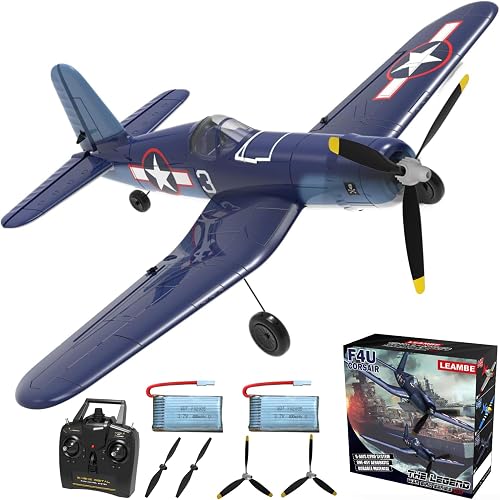 |  |  |  |  |  |
|---|---|---|---|---|---|---|---|---|---|---|
| Product | P51 Mustang RC Plane | 2 CH RC Glider | SU27 RC Fighter | 4DRC V32 Foam Plane | F4U Corsair RC Plane | SIMREX P51 Foam Glider | B25 Mitchell Bomber | DEERC BF-109 Fighter | SYMA X550 Tiltrotor | RGB LED RC Plane |
| Brand | LEAMBE | HAWK'S WORK | RoofWorld | 4DRC | LEAMBE | SIMREX | LEAMBE | DEERC | SYMA | TOIBUS |
| Best for | Top Pick | Best for Crash Resistance | Best for Ground Takeoff | Best for Stunt Flying | Best for Aerobatics | Best for Beginners | Best for Long Flights | Best for Dual Motors | Best for Tiltrotor Flight | Best for Night Flying |
| The listing says | Lightweight elastomer foam construction 3 flight modes for skill levels | Built-in self-stabilization system Durable foam structure resists crashes | Hand throw or ground takeoff 150-meter range with 2-channel control | Features 360-degree flips and altitude hold Equipped with bright LED lights | Simple operation with flight assistance 15-minute flight time and 656-foot range | Flexible EPP foam with 6-axis gyro Includes 2 batteries for 40+ minutes flight | Differential thrust steering and 2.4GHz control 40-minute total flight time with 2 batteries | 6-axis gyro stabilization system Lightweight EPP foam construction | Military-inspired design Multiple stunt flight modes | 8 LED lights with 13 modes 360-degree stunts and 3 speed modes |
| More information | Price on Amazon | Price on Amazon | Price on Amazon | Price on Amazon | Price on Amazon | Price on Amazon | Price on Amazon | Price on Amazon | Price on Amazon | Price on Amazon |
1. P51 Mustang RC Plane
Best for: Someone wanting a realistic plane with advanced flight control options.
This model is built for pilots who want to grow their skills, offering three flight modes: Beginner, Intermediate, and Experienced. The Xpilot stabilization system is designed to keep the plane steady during initial flights, while the lightweight elastomer foam helps keep it agile. If you’re struggling to keep the plane level, rely on the Xpilot gyro to provide self-stabilization. Switch to Experienced mode only once you have mastered the basics, as this setting removes the safety net for full aerobatic control.
The 8mm coreless motor provides enough power for maneuvers once you’re comfortable with the controls. Because it uses a 2.4GHz radio system, you get a range of 656 feet. If you lose signal or fly beyond this distance, the plane will become unresponsive. It isn’t ideal for very young children who lack the patience to learn different control modes, as this plane is designed for active piloting.
The Propeller Saver technology protects the motor during rough landings. If the propeller detaches upon impact, simply snap it back into place to resume flying. You can expect up to 12 minutes of flight time per charge.
Good if:
- You want to progress from beginner to expert modes.
- You need a compact 15.75-inch wingspan plane for outdoor fields.
- You value a stabilization system that assists with aerobatics.
Skip it if:
- You want a toy that requires zero learning curve.
- You need a plane for indoor use.
2. 2 CH RC Glider
Best for: A complete beginner who wants the simplest control scheme possible.
This glider focuses on ease of use with a 2-channel control system. The built-in self-stabilization helps the plane stay in the air with minimal input. A beginner will typically master the controls after just a few hours of practice.
The foam structure is designed to be lightweight and durable enough to survive minor crashes during the learning process. It’s a simple, no-frills choice for those who want to see a plane fly without worrying about complex maneuvers. If you find the plane behaving erratically, check the user manual first; the manufacturer reports that they can resolve almost all technical issues through their support channels.
The 2.4GHz radio system allows you to fly with others without mutual signal interference. If you’re flying with a friend, you can both launch your planes at the same time.
Good if:
- You’re a first-time pilot.
- You prefer simple up/down and left/right controls.
- You need a forgiving airframe for initial practice.
Skip it if:
- You want to perform stunts like loops or rolls.
- You need advanced flight surfaces.
- You aren’t willing to read the manual to troubleshoot common setup problems.
3. New Upgrade SU27 RC Airplane
Best for: Beginners who want a jet-style plane with stable flight characteristics.
The SU27 uses a 6-axis gyro stabilizer to make flying easier for new pilots. It offers two takeoff methods—hand-throwing or ground takeoff—giving you flexibility depending on your flying area.
The inclusion of an LED light bar makes it fun for evening flights. With 2 channels, the control is straightforward, though it lacks the advanced aerobatic depth of a 4-channel model. This plane isn’t designed for high-wind environments, so it’s best kept for calm, open outdoor spaces.
If you’re a novice, keep the throttle between 30% and 40% during your first flight. Avoid pushing the throttle to the maximum immediately, as this often leads to uncontrolled flight. You should only fly in conditions below level 4 wind to maintain control.
For the best results, charge the 3.7V batteries for 50 minutes to get 15 minutes of flight time. The listing doesn’t mention the consequences of exceeding the recommended 2-hour charge time. Assembly is quick, requiring only the battery, wheels, and tail.
Good if:
- You like the look of a fighter jet.
- You want an easy-to-assemble outdoor toy.
- You plan to fly at night.
Skip it if:
- You live in windy areas.
- You want complex maneuvers.
4. 4DRC V32 Foam Remote Control Airplanes RC Planes
Best for: Kids or adults who want to perform tricks and stunts easily.
This plane comes ready to fly with no assembly required. It’s packed with stunt features like 360-degree flips, rolls, and gravity sensing, which are triggered with simple button presses. If you’re a beginner, use the one-key takeoff and landing functions to avoid common crashes during your first few flights.
Safety is a focus here, as the four propellers are housed within a protective structure to prevent injury. The EPP material is soft yet sturdy enough to handle tumbles, making it a reliable choice for active play in your backyard or at a park. If the plane hits a wall, the foam construction absorbs the impact rather than shattering.
Good if:
- You prioritize stunt capabilities and aerial rolls.
- You enjoy flying at night, as the built-in LED lights create a glowing spectacle.
Skip it if:
- You want a realistic scale model for display.
- You’re looking for a long-range, high-speed aircraft.
- You need advanced flight telemetry, as this is designed for recreational play rather than serious, scale-accurate flight simulation.
5. F4U Corsair RC Plane
Best for: Pilots who want to transition into aerobatic maneuvers.
This plane offers a multi-channel control system that allows for more precise movement compared to entry-level toys with limited steering. The Xpilot stabilization system provides a safety net for beginners, but it can be adjusted through three levels to allow for stunts. If you’re struggling to keep the plane level, rely on the self-stabilization mode. If you want to perform loops or rolls, switch to the manual aerobatic mode.
With a flight time of up to 15 minutes, it offers a solid window of fun before needing a recharge. The wheels allow for ground takeoffs, though you can also use a hand-toss start. Because the plane reaches a maximum distance of 656 feet, it isn’t recommended for small indoor spaces. Its power and speed are best suited for large, open outdoor areas.
The EPP foam construction is designed to be crash-resistant, but you should always utilize the included propeller save feature. This prevents the blades from snapping during rough landings. If you’re a beginner, prioritize using the flight control assistance system until you master the controls.
Good if:
- You want to learn aerobatic maneuvers.
- You enjoy both hand-toss and ground takeoffs.
- You want a balance between stability and control.
Skip it if:
- You only have access to a small backyard.
6. SIMREX P51 Foam Glider
Best for: First-time pilots who want extra flight time and reliability.
The 6-axis gyro is the star here, providing automatic self-correction that makes the plane very forgiving of pilot errors. It comes with two batteries, which is a major advantage for those who want to fly for over 40 minutes without stopping. If you’re flying with friends, the 2.4GHz technology automatically hops between channels to prevent signal crossover.
The two speed modes allow you to start slow and increase the intensity as you get better. It’s built from flexible EPP foam, which is excellent for absorbing the impact of a crash. Beginners often make the mistake of flying over hard surfaces; avoid pavement and stick to soft grass or turf to cushion impacts and extend the life of the landing gear. This plane isn’t for those who want a high-speed, professional-grade racer.
Good if:
- You want a long total flight time.
- You’re a beginner who expects a few crashes.
- You want the choice between runway and hand-toss takeoffs.
Skip it if:
- You’re looking for a high-performance aerobatic jet.
- You want to fly in crowded, small spaces.
- You don’t have 3 AAA batteries ready for the controller.
7. B25 Mitchell RC Plane
Best for: Enthusiasts who want a detailed, scale-looking WWII plane.
This model is a replica of the B-25 bomber, making it a great choice for those who appreciate military history. It uses differential thrust steering, which is smooth and responsive for new pilots.
The XPilot stabilization system offers three levels of assistance, allowing you to grow your skills as you gain confidence. If you’re a beginner, start in the Beginner mode to let the 6-axis gyro correct your flight attitude in real time. Use the Expert setting only once you have mastered basic maneuvers. It’s a more complex model than the simple foam gliders, so it may be too much for a very young child without adult supervision.
Good if:
- You want a scale-replica look.
- You want the ability to perform one-key aerobatics.
- You value a long flight time with two included batteries.
Skip it if:
- You want the absolute simplest, most basic RC plane.
- You aren’t interested in military-style models.
If you fly in windy conditions, the FLEEX foam and carbon fiber ribs help, but avoid high-speed landings to protect the landing gear.
8. DEERC RC Plane 3 Channel BF-109 Remote Control Airplane Fighter
Best for: Pilots who want a powerful, fast-climbing RC fighter.
This model features dual motors, which provide extra power for speed and climbing. The 6-axis gyro system keeps it stable, ensuring that even with the added power, it remains controllable for beginners.
The 3-channel control system offers a good middle ground between simplicity and maneuverability. It handles bumps well thanks to the EPP foam construction. If you’re flying in an open field, use the hand-launch method for a quick start. If you have a smooth surface, you can slide it off the ground instead.
You can toggle between high and low speeds using the 2.4GHz remote. Keep the plane within its 656-foot control range to maintain a steady signal. With two 3.7V 350mAh batteries, you get about 20 minutes of total flight time.
It isn’t the right choice for someone who wants to fly in high winds. Its lightweight nature makes it difficult to control in gusts.
Good if:
- You want a powerful dual-motor system.
- You want an easy-to-fly fighter design.
- You need a plane that’s durable enough for outdoor use.
Skip it if:
- You want to fly in windy conditions.
- You are looking for an aerobatic plane capable of complex maneuvers.
9. SYMA X550 RC Plane
Best for: Pilots who want a unique, versatile flight experience.
The tiltrotor design sets this apart from standard fixed-wing planes, offering a different look and flight feel. It’s designed to perform stunts like circular routes and 360-degree spins, making it very entertaining for kids and teens. If you’re practicing in tight spaces, stick to the low-speed setting to maintain control. Switch to high speed only when you have mastered the basics and are flying in calm, no-wind outdoor air.
The one-key takeoff and landing feature removes the stress of the most difficult parts of flight. Use this function if you’re a beginner prone to early crashes; it prevents the frustration that leads many novices to quit. It’s highly versatile, suited for both indoor practice and calm outdoor days. It isn’t for someone looking for a traditional, realistic airplane flight experience or those who intend to fly in gusty weather.
Good if:
- You want a unique-looking aircraft.
- You value easy takeoff and landing features.
- You enjoy performing stunts.
Skip it if:
- You want a traditional, realistic plane replica.
- You plan to fly primarily in windy outdoor conditions.
10. RGB LED RC Plane
Best for: Flying enthusiasts who love visual effects at night.
The RGB LED strips with 13 modes make this plane a spectacle after dark. Beyond the lights, it’s built with an Armor-Grade PC shell, which is tougher than standard foam and resists scratches and impacts. If you’re flying over pavement or rough ground, this shell prevents the common structural damage that ruins foam models.
The advanced control system and 3 speed modes provide enough depth for beginners to grow into. Use the lowest speed setting to learn basic maneuvers in open spaces. Once you master the controls, switch to higher speeds to execute 360-degree flips and auto-rotation stunts.
The 2.4GHz system allows you to fly with friends without signal crosstalk. If you experience a sudden loss of control, check your battery levels; the plane includes low-battery warnings to prevent mid-air power failure. It’s a safe and sturdy choice for families who want a plane that stands out in the sky.
Good if:
- You want a high-visibility plane for night flying.
- You prefer a tougher, harder-shell construction.
- You want stunt capabilities like auto-rotation.
Skip it if:
- You prefer the lightweight, bouncy nature of foam planes.
- You want a realistic, scale-model appearance.
Choosing the best rc plane for kids
Most of these planes share the same core DNA: they use 2.4GHz radio systems to avoid signal interference, they rely on EPP or elastomer foam for crash resistance, and they almost all include some form of gyro stabilization. For a new pilot, the SIMREX P51 Foam Glider and the P51 Mustang RC Plane are quite similar in their goal of making flight accessible, though the latter offers more advanced aerobatic control for those ready to move beyond basic flying.
The main difference is usually between models limited to basic steering and those that allow for complex maneuvers like rolls and loops. If you’re choosing between the SU27 RC Fighter and the DEERC BF-109 Fighter, you’re essentially picking the look you prefer, as both offer similar stabilization and power levels. The choice rarely comes down to flight quality alone, but rather which aesthetic, stunt feature, or flight duration package best fits your needs. If you’re unsure, remember that the Consumer Product Safety Commission provides general safety guidelines for children’s toys that can help you understand how to manage battery and mechanical risks.
Still Not Sure?
How often will I really use it?
If you plan to fly only occasionally in the backyard, a simple, ready-to-fly foam glider like the 2 CH RC Glider is ideal. It requires very little setup and is easy to store. If you’re looking for a new hobby and plan to visit parks every weekend, you’ll appreciate the performance and battery life of the SIMREX P51 Foam Glider.
What do I already own that this has to work with?
Most of these planes come as a complete package, including the remote and batteries. However, check if the remote requires extra AAA batteries, as is the case with the SIMREX P51 Foam Glider. For a first-time buyer, sticking to the RTF (Ready-to-Fly) kits like the B25 Mitchell Bomber is the most stress-free path.
What am I most likely to regret choosing?
The most common regret is buying a plane that’s too advanced for your skill level. If you’re a total beginner, choosing a high-speed, fully maneuverable aerobatic plane like the F4U Corsair RC Plane might lead to frustration if you crash repeatedly. Start with a model that has an “easy” mode or a 6-axis gyro, such as the SU27 RC Fighter, to ensure your first few flights are successful and fun rather than a series of repairs.
The best choice depends on whether you value stunts and night visuals or stable, realistic flight. For those wanting a reliable, beginner-friendly experience with long flight times, the SIMREX P51 Foam Glider is excellent. If you’re looking for a stunt-focused plane with protective features for kids, the 4DRC V32 Foam Plane is the way to go. Check your local park space, pick the model that matches your skill level, and enjoy your time in the sky.
Frequently Asked Questions
How do I know if the plane is suitable for a beginner?
Beginner-friendly planes feature integrated 6-axis gyro stabilization to automatically correct flight attitude and prevent crashes. Models like the SIMREX P51 Foam Glider and B25 Mitchell Bomber include these systems to help new pilots stay level. Always look for planes that offer a “Beginner” flight mode to restrict controls.
Can I fly these planes in my backyard?
Lightweight foam planes like the P51 Mustang or SU27 RC Fighter perform best in open, grassy areas that cushion landings and preserve the foam body. Avoid flying near trees, power lines, or busy streets. For tighter spaces, look for models with a “Low Speed” mode, such as the SYMA X550 Tiltrotor.
What happens if I crash my RC plane?
These planes are made from EPP or elastomer foam, which is lightweight and impact-resistant to withstand minor crashes. Many models, such as the P51 Mustang, feature “Propeller Saver” technology that allows the propeller to pop off during impact to prevent motor damage. Always inspect the frame and propellers after a crash.
Do I need to buy anything else before I can fly?
Most of these kits are sold as “Ready-to-Fly” (RTF), meaning they include the plane, the remote, the battery, and a charger. However, you should check the listing to see if the remote control requires its own set of batteries, as these are often not included in the box. For example, the SIMREX P51 Foam Glider requires you to provide your own AAA batteries for the remote.
Conclusion
Picking the right aircraft is just the start of your journey into the skies. Once you’ve unboxed your new flyer, head to a wide, open park with plenty of soft grass for those inevitable bumpy landings. You’ll have a blast as you gain confidence and start soaring through the air with ease.


