
Choosing the right remote control plane means balancing your skill level against the plane’s flight modes and durability. While some models prioritize high-speed aerobatics for experienced pilots, others focus on stability systems to help beginners learn safely. The key difference lies in how much control assistance the software provides versus how much manual input is required.
Best overall: Brushless F4U Corsair, which offers three flight assistance levels and a high-performance brushless motor, making it a versatile choice that grows with the pilot’s skill from beginner to expert.
Best for beginners: P-40 Warhawk, as it features a dedicated Xpilot stabilization system and EPP foam construction, specifically designed to help new flyers learn the basics while resisting crash damage.
Best for performance: DEERC F35 Thunderbirds, which utilizes a powerful 7400KV brushless motor and a high thrust-to-weight ratio to deliver advanced aerobatic capabilities for pilots seeking speed and precision.
This guide is for hobbyists looking for reliable, ready-to-fly aircraft that provide consistent performance across various skill levels.
How We Picked
We compared 48 different remote control plane listings on Amazon to find the best options for various pilot types. To earn a spot, each plane had to clearly state its channel count, stabilization features, and materials used in the fuselage. We prioritized models that included essential flight accessories like batteries and spare propellers, as these items are crucial for immediate use. Any product that failed to provide clear information on control range or flight modes was excluded from our final selection to ensure our readers have accurate data for their purchase.
All 10 products side by side — scroll sideways to see every column.
| Top Pick | Best for Beginners | Best for High Speed | Best for Water | Best for Stunts | ||||||
| Preview | 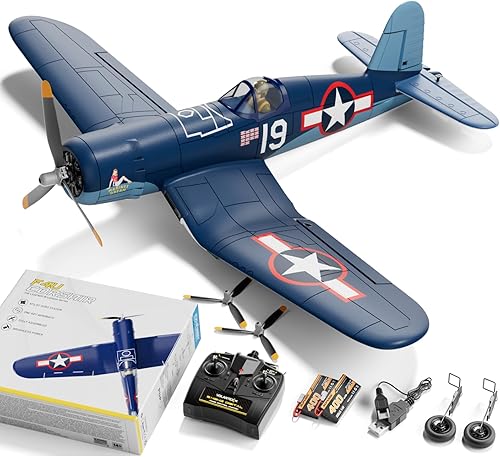 |  |  |  |  |  |  |  |  |  |
|---|---|---|---|---|---|---|---|---|---|---|
| Product | Brushless F4U Corsair | P-40 Warhawk | DEERC F35 Thunderbirds | Volantexrc T28 Trojan | P51 Mustang | DEERC Z62 Amphibious | B25 Mitchell | DEERC Eagle | SYMA X550 Tiltrotor | F22 Raptor |
| Brand | LEAMBE | LEAMBE | DEERC | DIAMONDDYNAMICS | LEAMBE | DEERC | LEAMBE | DEERC | SYMA | HAWK'S WORK |
| Best for | Best Overall | Best for Beginners | Best for High Speed | — | — | Best for Water | — | — | Best for Stunts | — |
| The listing says | Three levels of flight control assistance High-performance brushless motor | Simple operation with stick control Up to 15 minutes flight time | 7400KV1104 brushless motor 4-channel system for precise control | 3-level flight control assistance Xpilot gyro stabilization system | Lightweight elastomer foam construction Three flight modes for all levels | 3 channel land and water operation Ground, hand-toss, or water takeoff | Differential thrust steering Up to 40 minutes total flight time | 6-axis gyroscope stabilization system Molded EPP material construction | Supports 360° spins and circular routes Two speed settings for training | Built-in self-stabilization system Durable foam structure |
| More information | Check Price on Amazon | Check Price on Amazon | Check Price on Amazon | Check Price on Amazon | Check Price on Amazon | Check Price on Amazon | Check Price on Amazon | Check Price on Amazon | Check Price on Amazon | Check Price on Amazon |
1. Brushless 4 Channel RC Plane F4U Corsair 500mm Remote Control
Best for: Pilots who want a versatile plane for all skill levels.
The Brushless F4U Corsair stands out due to its high-performance brushless motor, which provides more efficiency than standard motors. Its three-level flight assistance system allows you to build confidence at your own pace, eventually switching to full manual control for advanced maneuvers. While the DEERC F35 Thunderbirds offers similar performance, this model is built with features like spring-loaded landing gear that simplify maintenance for hobbyists.
The plane includes two batteries, which is a major benefit for extended flying sessions in the park. However, it requires AA batteries for the remote, which aren’t included in the box. This model isn’t for someone looking for a tiny indoor-only flyer, as its 656-foot range and outdoor-focused design are meant for open spaces.
-
Pros:
- Three levels of flight assistance
- Powerful high-performance brushless motor
- Includes two rechargeable batteries
-
Cons:
- Requires separate AA remote batteries
- Designed primarily for outdoor use
2. P-40 Warhawk
Best for: New pilots learning the basics of flight.
The P-40 Warhawk is designed with the Xpilot stabilization system, providing the necessary self-leveling to keep the plane steady during your first few flights. Its EPP foam material is a significant advantage, as it absorbs impact energy during rough landings or minor accidents. Compared to the Volantexrc T28 Trojan, this plane focuses more on a simple, streamlined setup for those just starting in the hobby.
The inclusion of a propeller saver is a thoughtful detail, preventing damage to the blades if you strike an obstacle. The P-40 Warhawk provides up to 15 minutes of flight time per battery, so you’ll need to manage your time carefully. This plane isn’t for advanced pilots looking for high-speed, complex aerobatic competition, as its design prioritizes stability over extreme performance.
-
Pros:
- Durable EPP foam construction
- Built-in Xpilot stabilization system
- Propeller saver technology included
-
Cons:
- Limited to 15 minutes per flight
- Not built for high-speed racing
3. DEERC F35 Thunderbirds Brushless 4 Channel RC Plane
Best for: Pilots who want maximum speed and power.
The DEERC F35 Thunderbirds is a high-performance aircraft featuring a 7400KV brushless motor that provides a thrust-to-weight ratio greater than 1.2. This power allows for impressive aerobatics like 360-degree spins and mirror flight, making it a favorite for those who have moved past basic training. Unlike the Brushless F4U Corsair, this model uses an EDF (Electric Ducted Fan) design, which mimics the look and sound of real fighter jets.
The plane includes two 550mAh batteries, offering up to 20 minutes of flight time, which is helpful for practicing complex stunts. It’s important to follow the manual’s specific pairing instructions if the controller doesn’t connect immediately. This model isn’t for absolute beginners who have never flown, as its high power and agile handling require a steeper learning curve than a standard trainer.
-
Pros:
- High-thrust brushless motor system
- Realistic fighter jet design
- Durable premium foam structure
-
Cons:
- Requires skill to master agility
- 500-foot range is shorter than others
4. Volantexrc RC Airplane 2.4Ghz 4 Channel Remote Control
Best for: Beginners who want a stable trainer.
The Volantexrc T28 Trojan is a classic trainer that uses the Xpilot stabilization system to help you learn through a graduated progression of assistance. The beginner mode provides full assistance, which is essential for preventing common pilot errors during the first few hours of flight. Compared to the P51 Mustang, this model is specifically marketed as a parkflyer, making it a great choice for smaller outdoor areas.
The gearbox system is designed to provide extra thrust while remaining efficient, which extends flight time to about 20 minutes. It’s ready to fly in one minute, which is excellent for those who dislike complicated assembly processes. This plane isn’t for users who want to fly in strong, gusty winds, as its lightweight design can be affected by high-speed air currents.
-
Pros:
- Three-level flight control assistance
- Quick one-minute assembly time
- Efficient gearbox for longer flights
-
Cons:
- Requires separate batteries for transmitter
- Lightweight frame vulnerable to wind
5. P51 Mustang
Best for: Pilots who enjoy scale replica planes.
The P51 Mustang is an excellent scale model that provides a realistic experience while remaining accessible to newer pilots. It features propeller saver technology, which is a vital feature for those who are still learning to land safely on grass or uneven ground. While similar to the P-40 Warhawk in its use of the Xpilot system, this plane stands out for its detailed military aesthetic.
The 8mm coreless motor provides enough power for aerobatic maneuvers, and the lightweight elastomer foam makes it quite resilient. You should read the manual closely to understand how to switch between the various levels of flight assistance properly. This plane isn’t for pilots who need a long-range flyer, as its control distance is limited to 656 feet.
-
Pros:
- Propeller saver technology included
- Realistic scale replica design
- Three flight modes for flexibility
-
Cons:
- 12-minute flight time is short
- Limited to 656-foot range
6. DEERC Z62 RC Plane
Best for: Pilots who want to fly on water and land.
The DEERC Z62 Amphibious is unique because it can take off from water, land, or be hand-thrown, offering more location flexibility than any other pick in this article. The waterproof design allows for worry-free flying over lakes, and the EPP material is specifically chosen to resist damage from minor crashes. Unlike the DEERC Eagle, this plane can be maneuvered back to you if it capsizes on the water.
You get over 24 minutes of flight time with the two included batteries, which is quite impressive for a craft with this level of versatility. The low battery and out-of-range alerts are important safety features that help prevent losing the plane. This model isn’t for pilots who want a high-speed fighter jet, as it’s designed for gliding and amphibious exploration rather than intense aerobatics.
-
Pros:
- Capable of taking off from water
- Over 24 minutes of flight time
- Waterproof design for safety
-
Cons:
- Not built for high-speed stunts
- 3-channel control is less precise
7. B25 Mitchell RC Plane
Best for: Pilots who want a twin-motor bomber.
The B25 Mitchell features a twin-motor system that provides strong thrust and a solid climb rate, making it a great choice for those who want a bomber replica. It uses differential thrust for steering, which simplifies the controls for new pilots who might find ailerons difficult to manage initially. Compared to the Brushless F4U Corsair, this bomber offers a unique twin-motor flight experience with a 40-minute total flight time.
The inclusion of carbon fiber reinforcing ribs in the wings adds significant durability, helping the plane maintain its shape during aggressive maneuvers. The one-key aerobatic function is a fun addition for showing off loops and rolls without needing advanced manual skills. This plane isn’t for those who want a compact, single-motor jet, as the twin-motor setup requires slightly more attention during take-off.
-
Pros:
- Twin-motor system for power
- 40 minutes total flight time
- Carbon fiber reinforced wings
-
Cons:
- Requires more space to operate
- Uses 3-channel control system
8. DEERC 2CH Eagle RC Plane
Best for: Pilots who want a lifelike bird design.
The DEERC Eagle is a visually striking model that looks like a real bird in the air, making it a great conversation starter at the park. Its 6-axis gyroscope provides the same stability found in more traditional planes, ensuring that even beginners can keep it in the sky. Unlike the SYMA X550 Tiltrotor, this model is designed for simplicity and realistic flight behavior rather than stunts.
The included power cells provide up to 22 minutes of flight time, which is very respectable for such a specialized design. It’s easy to maintain, and the EPP construction ensures it can handle the occasional bump. This plane isn’t for someone who wants a high-speed fighter, as its flight performance is focused on mimicking bird-like movement.
-
Pros:
- Realistic bald eagle appearance
- 6-axis gyro for stability
- Durable EPP material
-
Cons:
- 2-channel control is limited
- Not designed for stunts
9. SYMA X550 RC Plane
Best for: Pilots who want to perform stunts.
The SYMA X550 Tiltrotor is a fun, stunt-focused plane that can perform 360-degree spins and jump flights, making it feel like a mini air show. Its military-inspired look is great for display on a shelf when you aren’t using it. The one-key takeoff and landing feature removes the stress of getting into the air, which is perfect for teens and beginners who want to start flying immediately.
The two-speed setting allows you to start slow and increase the intensity as your skills improve. Compared to the DEERC F35 Thunderbirds, this model emphasizes acrobatic fun over pure speed. This plane isn’t for outdoor flying in windy conditions, as its light weight and unique rotor configuration are best suited for calm, no-wind days.
-
Pros:
- Capable of 360-degree spins
- One-key takeoff and landing
- Two speed settings included
-
Cons:
- Best for calm weather only
- Not for high-wind outdoor use
10. 2CH RC Plane F22 Raptor
Best for: Pilots who want a compact fighter jet.
The F22 Raptor is a great entry point into RC planes, featuring a simple self-stabilization system that makes learning to fly much easier. Its lightweight foam structure is durable enough to survive minor crashes, which is common for new pilots. While it doesn’t have the advanced aerobatic features of the DEERC F35 Thunderbirds, it’s a great choice for those who want a simple, no-fuss experience.
The 2.4GHz radio system ensures that you can fly with friends without interference, which is a nice touch for a compact model. The manufacturer also includes a one-year aircraft warranty, providing extra confidence in your purchase. This plane isn’t for someone who wants to perform high-level stunts, as it’s primarily designed for simple, stable glides.
-
Pros:
- Self-stabilization system included
- One-year aircraft warranty
- 2.4GHz interference-free control
-
Cons:
- 2-channel control limits movement
- Limited aerobatic capability
How to Choose in Sixty Seconds
Flight Control Assistance
The most important feature for a new pilot is the inclusion of a gyro stabilization system. These systems, often called Xpilot or 6-axis stabilization, automatically correct the plane’s attitude to keep it level. If you’re a beginner, prioritize models that offer a range of assistance levels, from beginner to expert. This allows you to start with full help and slowly transition to manual control. Avoid models that lack any form of stabilization, as they’re much harder to fly and prone to crashing quickly. Always confirm that the plane includes this technology before purchasing, as it’s the single biggest factor in your success as a new flyer.
Battery and Flight Time
Remote control planes are only fun while they’re in the air, so pay close attention to the included battery capacity and quantity. Many modern kits include multiple power cells, effectively doubling your flight time. Look for models that offer at least 15 to 20 minutes of flight per charge to ensure you get enough practice without needing to head home too early. Check if the batteries are proprietary or standard, as having extra batteries on hand is a great way to extend your session. Remember that flight times listed by manufacturers are often estimates; flying in windy conditions or at high speeds will drain your power faster.
Material and Durability
EPP foam is the industry standard for these planes because it’s lightweight, flexible, and highly resistant to impact damage. When choosing, look for models that specifically mention EPP foam or “crash-resistant” materials. Some models also include carbon fiber reinforcement, which adds structural integrity to the wings and fuselage. These features are essential for beginners who will inevitably have a few rough landings. You should also check if the manufacturer includes spare parts like extra propellers or a propeller saver feature. These components are listed as replaceable parts, and having spares or a protective design can save you from having to buy a new plane.
For those interested in the safety and regulations regarding small unmanned aircraft, the Federal Aviation Administration provides clear guidance for recreational flyers on where and how to operate these hobby planes safely.
The Brushless F4U Corsair remains our top pick for its perfect balance of high-performance features and beginner-friendly assistance, while the P-40 Warhawk is the ideal choice for those who want to start their flying journey with maximum stability. Both models offer the durability and ease of use that make the hobby enjoyable for everyone. Once you have chosen your preferred model, make sure to read the provided user manual thoroughly and practice your first flights in a wide-open space away from trees, power lines, and people. Getting comfortable with the controls in a safe environment is the best way to ensure your plane survives its first few outings and provides you with many hours of entertainment.
Frequently Asked Questions
Do I need to buy extra parts to fly these planes?
Most listed planes are “Ready to Fly,” meaning they include the aircraft, remote, and flight battery. You should check the box for extra AA batteries, as many remotes require them separately. Some models include everything except these remote batteries, so keep a spare pack on hand.
How do I control the plane if I have never flown before?
All recommended picks feature stabilization systems to assist new pilots. You should start in “Beginner” mode, which limits tilt and keeps the plane level to prevent crashes. If you lose control, simply release the sticks, and the system will return the plane to a level flight path automatically.
Can I fly these planes in the wind?
These planes feature 6-axis gyros to resist wind, but they are lightweight and best suited for calm days. Smaller models are affected by light breezes, while larger models handle wind slightly better. As a beginner, fly only when the air is calm to maintain control and prevent the plane from drifting.
What should I do if the plane crashes?
We selected planes made from durable EPP foam to withstand inevitable crashes. If you crash, first inspect the propeller for damage, as it is a common failure point. If you find cracks in the wings or fuselage, you can often repair them using a small amount of foam-safe glue.
Conclusion
Once you’ve picked your first model, don’t rush your maiden flight. Find a wide-open park on a calm day to practice your takeoffs and landings. You’ll find that patience makes the hobby much more enjoyable. It’s a great way to spend an afternoon, so get out there and start flying.


