Choosing a remote-control car depends on whether you want pure speed, rugged durability for outdoor bashing, or simple controls for younger drivers. The major differences between these models lie in their chassis materials, motor types, and whether they include hobby-grade features like oil-filled shocks or waterproof electronics for all-terrain play.
Best overall: Brushless 1:14 RC Truck, which features a powerful brushless motor and 3S battery capability to reach speeds of 50+ mph, making it the top choice for those who prioritize raw performance and speed. Most durable: 1:16 Metal Chassis Truck, which uses a reinforced metal chassis and metal drivetrain components to handle harsh impacts and rough terrains better than standard plastic-based hobby cars. Best for beginners: Tuko Kids Edition Car, which is designed with a simple control scheme and rounded edges, making it safe and easy for children ages 3 and up to operate.
This guide is for anyone looking to enter the world of RC cars, from hobbyists wanting high-speed trucks to parents seeking safe toys.
How We Picked
We compared 48 different Amazon listings to find the best options for various skill levels and interests. To be included, a product had to clearly state its motor type, chassis material, battery runtime, and included accessories. We excluded any listings that lacked clear technical specifications or failed to provide information on battery compatibility. Our selection focuses on the balance between build quality, speed, and ease of use as stated by the manufacturers.
All 10 products side by side — scroll sideways to see every column.
| Top Pick | Runner-Up | Also Great | Best for Drifting | Best for Stunts | Best for Water | Best for Toddlers | ||||
| Preview |  |  |  |  |  |  |  |  |  | 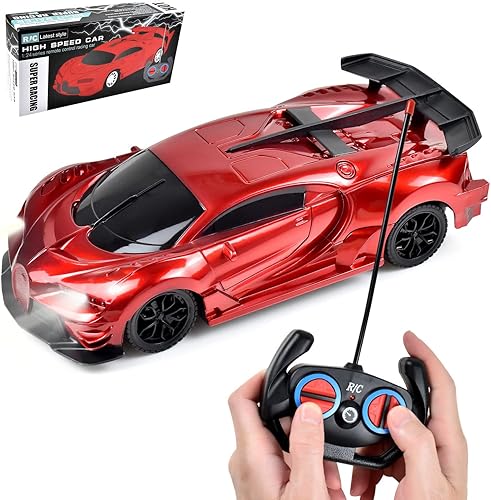 |
|---|---|---|---|---|---|---|---|---|---|---|
| Product | Brushless 1:14 RC Truck | 1:16 Metal Chassis Truck | TENSSENX 1:18 RC Car | HAIBOXING 18859 RC Car | FPV Offroad RC Car | 1:24 JDM Drift Car | QUNREDA 4WD Stunt Car | MSMV Amphibious RC Car | Tecnock 1:18 RC Buggy | Tuko Kids Edition Car |
| Brand | WIAORCHI | WIAORCHI | TENSSENX | HAIBOXING | TOPRCBOXS | Highmall | QUNREDA | MSMV | Tecnock | Tuko |
| Best for | Best Overall | Runner-Up | Also Great | — | — | Best for Drifting | Best for Stunts | Best for Water | — | Best for Toddlers |
| The listing says | Features steel drivetrain and composite bumper 6061 aluminum chassis with composite brace | Metal chassis, differential, and drive shaft 380 brushed motor reaches 40KM/H | 1:18 scale with 40+ km/h top speed Large tires with metal hub sheets | Brushed 380 motor reaches 36 KPH Hobby class design with independent suspension | Fixed high-definition camera included HD-screen controller for real-time FPV | Compact JDM style van design Includes racing and drift tire sets | Two 500 mAh batteries for 50 minutes total Type-C interface for modular battery charging | 1:20 scale waterproof amphibious design 4-wheel drive with anti-skid tires | USB-C charging with 50-minute runtime 1:18 scale reaches 20 km/h | Durable ABS plastic construction Portable 8.5x 4x 2.2inch size |
| More information | Buy on Amazon | Buy on Amazon | Buy on Amazon | Buy on Amazon | Buy on Amazon | Buy on Amazon | Buy on Amazon | Buy on Amazon | Buy on Amazon | Buy on Amazon |
1. Brushless 1:14 RC Truck
Best for: Serious hobbyists wanting extreme speed and performance.
This truck is built for speed, utilizing a 2852 4200KV brushless motor that can push the vehicle to 50+ mph. The inclusion of steel differential outdrives and a metal gearbox helps manage this high torque, providing a more robust drivetrain than standard brushed models. Its 6061 aluminum chassis adds 50% more durability than typical models, protecting the internal components during high-speed impacts.
The 3S battery capability is a feature for those who want to upgrade their performance. If you are a new basher, use the transmitter to set the throttle limit to 70%. Only move to full power once you have mastered the handling of the 4×4 drivetrain.
Pros
- Reaches speeds up to 50+ mph.
- Durable metal gearbox and chassis.
- Brushless motor for high efficiency.
- 44 minutes of playtime with dual batteries.
Cons
- Requires careful handling at full speed.
- Not intended for small children.
2. 1:16 Scale All Terrain Fast RC Cars for Adults 40KPH
Best for: Drivers who need a rugged, impact-resistant vehicle.
The metal chassis and drivetrain components distinguish this truck from plastic-only models. It’s designed to handle rough surfaces like gravel and mud without the frame flexing or breaking under stress. You should prioritize this build if you frequently navigate uneven terrain where hard impacts are inevitable.
The IPX4 waterproof rating allows for play in wet conditions, though users must still clean the truck after running it through puddles to prevent long-term corrosion. This model isn’t suited for those looking for the absolute fastest racing speeds, as the 380 brushed motor is tuned for torque rather than top-end velocity. If you choose this truck, expect 40KM/H performance.
Pros
- Sturdy metal chassis construction.
- Waterproof electronics for all-terrain use.
- Includes two long-lasting batteries for 40 minutes of total runtime.
Cons
- Slower top speed than brushless models.
If you’re a first-timer, the dual-battery setup is a major advantage. It prevents the frustration of short play sessions common with smaller, single-battery RC cars. Always swap the batteries once the power drops to maintain motor health.
3. TENSSENX 1:18 RC Car
Best for: Enthusiasts wanting precise, proportional speed control.
This 1:18 scale truck offers a balance of size and performance, featuring a 380 brushed motor capable of hitting 40+ km/h. Its hobby-grade design includes independent suspension and ball bearings, which help the car track straight and handle jumps during off-road sessions.
The proportional control system is a major benefit, allowing the driver to fine-tune speed and steering rather than just having “on/off” inputs. If you’re driving on loose surfaces like sand or gravel, use the throttle sensitivity to prevent the tires from spinning out. You can maintain control across 300 feet of range, making it ideal for large parks or open fields.
This car isn’t recommended for indoor use in small spaces. Its speed and power can make it difficult to manage without enough room, leading to collisions that risk damaging the PVC body. Always check your surface; if the ground is smooth, the car responds instantly, but bumpy terrain requires the full travel of the independent suspension.
Pros
- Proportional throttle for precision control.
- Independent suspension for rough terrain.
- Included spare battery extends playtime.
Cons
- Too fast for small indoor areas.
- Requires open space for safety.
4. HAIBOXING 18859 RC Car
Best for: Those who want a true hobby-grade experience.
This truck is a classic example of hobby-grade engineering in a smaller 1:18 scale. With its solid gear differential and independent suspension, it provides a stable driving experience on gravel and dirt roads.
The manufacturer emphasizes that all parts are available for service, which is a major advantage for long-term ownership. It isn’t the right choice for someone who wants a “plug and play” toy that requires zero maintenance or understanding of battery charging protocols.
If you’re new to Li-Po batteries, prioritize the manual’s safety section. Using a charger with an output other than 5V 2A can damage the cells or shorten their lifespan significantly. Always pair the vehicle with the transmitter immediately after powering on to ensure the 2.4GHz signal remains stable within the 280-foot range.
Pros
- Hobby-grade parts are fully replaceable.
- Stable 4WD performance on dirt.
- Proportional radio control system included.
- 40 minutes of total runtime from two included packs.
Cons
- Requires specific 5V 2A charging.
- Not for those avoiding maintenance.
- Requires manual pairing for a reliable connection.
5. FPV Offroad RC Car
Best for: Users who want an immersive, camera-based driving experience.
The integrated HD camera and screen-equipped controller turn this RC car into a unique tool for exploration. You view the driving path in real-time without needing a smartphone or app download, which simplifies the setup process. Because the controller handles the signal directly, you avoid the lag or connectivity drops often found in mobile-tethered systems.
The alloy body adds durability against collisions while navigating obstacles. If you’re driving on loose gravel or uneven dirt, the independent suspension and reinforced front bumper prevent the chassis from bottoming out. However, this isn’t the best pick for pure racing enthusiasts. The added weight of the camera system and the screen-based control focus prioritize visuals over raw speed.
If you plan to drive with others, the 2.4 GHz system is your best friend. It prevents signal interference, allowing multiple vehicles to operate simultaneously without crossing frequencies. You get two rechargeable batteries included in the box, providing a total of 40 minutes of runtime. If the car feels sluggish, check that your terrain isn’t too steep for the alloy frame.
Pros
- Built-in camera for FPV.
- No smartphone or app needed.
- Durable alloy construction.
Cons
- Slower than dedicated racing trucks.
- Camera adds weight to the chassis.
6. 1:24 JDM Drift Car
Best for: Indoor racing and drift enthusiasts.
This compact vehicle is modeled after JDM styling and is specifically designed for sliding and drifting on smooth surfaces. The inclusion of multiple tire options allows you to switch between racing grip and drift sliding, making it highly versatile for its size. If you want to practice technical maneuvers, swap to the drift tires; use the racing tires for better traction on tight corners.
Because it’s a 1:24 scale, it’s best used on flat, indoor floors rather than outdoor trails. It isn’t designed to handle grass, rocks, or uneven dirt. The car is compact and ideal for indoor racing. It’s a poor choice for someone planning to bash the car in a backyard.
The kit includes mini traffic cones, which let you build custom obstacle courses to test your control. Use the USB-rechargeable lithium battery to keep the car running for extended sessions.
Pros
- Compact size for indoor play.
- Includes specialized drift tires.
- LED lights for night driving.
Cons
- Limited to smooth indoor surfaces.
- Small size isn’t for off-roading.
7. QUNREDA 4WD Stunt Car
Best for: Kids who enjoy performing tricks and flips.
This stunt car is built for agility, capable of 360-degree flips and spins that standard trucks can’t perform. The modular battery system is particularly helpful for parents, as it allows for tool-free, safe battery swaps. Each 500 mAh battery provides 25 minutes of play, and you can swap in the spare to reach 50 minutes of continuous action.
The 2.4GHz anti-interference technology ensures that multiple cars can play together without signals crossing at distances up to 50 meters. Use the red-eye LED headlights to track the car’s orientation during complex maneuvers. It isn’t meant for high-speed linear racing, as the design focuses on rotation and acrobatics rather than straight-line velocity. If you’re racing on uneven surfaces like sand or grass, rely on the high-quality ABS tires for necessary grip.
Pros
- Performs 360-degree flips and spins.
- Easy modular battery swapping.
- USB-C charging for convenience.
Cons
- Not designed for high-speed racing.
- Limited range compared to larger, professional-grade hobby trucks.
8. MSMV Amphibious Remote Control Car
Best for: Play in wet environments like pools, rivers, or beaches.
The fully sealed electronic components allow this car to transition seamlessly from land to water. It’s a unique option for families who spend time near lakes or pools and want a toy that won’t fail when it touches water. Because the motors are designed for versatility rather than pure velocity, expect lower speeds on land compared to specialized racing trucks.
The 360-degree rotation capability adds a fun element to water play, while the 2.4GHz remote ensures you can race multiple cars at once without signal interference. If you’re racing on grass or gravel, the shock-absorbing tires provide the necessary grip to keep moving.
Pros
- Fully waterproof for water play.
- Durable ABS material construction.
- 60-minute runtime per battery.
- Includes a spare power pack for extended play.
Cons
- Slower speeds on land.
- Not built for high-speed racing.
- Requires 2-3 hours of charging time per battery.
9. Tecnock RC Cars Remote Control Car
Best for: Beginners wanting long runtimes with simple charging.
This buggy is designed for simplicity, featuring a built-in 1500mAh battery and a direct USB-C charging port. It removes the need to constantly remove and replace battery packs, making it very user-friendly for younger drivers or those new to the hobby. If you want to get driving immediately, the included remote batteries mean you won’t have to buy any extra parts to start.
The 50-minute runtime is excellent for continuous play. The Brushless 1:14 RC Truck features a 4200KV, 4-pole high-torque motor with a metal heatsink and waterproof receiver. The 1:16 Metal Chassis Truck offers a 40KM/H top speed with a high-torque 380 brushed motor. The HAIBOXING 18859 provides a 280-foot control range.
The 2.4GHz system allows you to race multiple cars at once within a 98-foot range without signal interference. If you’re racing with friends, this stability is a major advantage.
Pros
- Simple USB-C direct charging.
- Long 50-minute runtime.
- Durable PVC shell construction.
Cons
- Battery is built-in, not swappable.
- Limited upgrade path for parts.
10. Tuko Remote Control Car Toys
Best for: Very young children (ages 3+).
This car is engineered for small hands and safety, featuring rounded edges to prevent potential injuries. The remote is designed to fit a child’s grip, making it a great first experience for toddlers.
The HAIBOXING 18859 RC Car features a 2.4GHz full-function proportional radio control system with a 280-foot range. The 1:16 Metal Chassis Truck includes a high-torque 380 brushed motor capable of 40KM/H. The Brushless 1:14 RC Truck utilizes a 4200KV, 4-pole high-torque motor with a metal heatsink and waterproof receiver.
To steer, children must press the forward or backward button simultaneously with the left or right button. If the car fails to turn, check that the child is pressing both directional inputs at once. You’ll need five 1.5v AA batteries to operate the unit: three for the car and two for the controller.
Pros
- Safe design with rounded edges.
- Intuitive, simple remote controls.
- Durable, non-toxic ABS plastic.
Cons
- Lacks speed for older users.
- Not for outdoor off-road use.
- Requires five batteries not included in the box.
How to Choose in Sixty Seconds
Which motor type is better: brushed or brushless?
Brushless motors provide high speeds and performance, as seen in the Brushless 1:14 RC Truck. Brushed motors, such as those in the HAIBOXING 18859 RC Car, utilize a 380 high-torque motor to provide power for off-roading. These brushed systems are designed for beginners learning the basics of RC driving.
If you’re a new basher, check if the transmitter allows you to set throttle limits. Some brushless models allow you to cap speed at 70% until you master the controls. Ignoring this setting often leads to immediate collisions for inexperienced drivers.
Does the chassis material matter for my driving style?
Yes, the chassis material determines how much abuse the car can take. A metal chassis, like the one on the 1:16 Metal Chassis Truck, adds weight but provides significant rigidity and durability when hitting jumps or rocks. This is ideal if you plan to bash your car in rough terrain. Plastic or composite chassis, found on models like the Tecnock 1:18 RC Buggy, are more flexible.
What should I check before buying a specific model?
Before ordering, confirm the battery type and charging method. Some models, like the Tecnock 1:18 RC Buggy, feature built-in batteries with USB-C charging, which is very convenient. Others, like the HAIBOXING 18859 RC Car, use removable Li-Po battery packs that require careful handling and specific chargers to prevent damage. Always ensure the model you choose matches your ability to manage the battery maintenance.
If your model uses Li-Po batteries, you must verify the charger output. The listing for the HAIBOXING 18859 RC Car states to ensure you use a compatible charger with an output of 5V 2A for proper charging. Always read the specific battery usage page in the manual before the first charge. Additionally, verify if the car includes spare parts or if parts are easily available on the market. A model with an available parts supply, like the HAIBOXING series, is a much better long-term investment than a generic model that might be impossible to repair after a crash.
The Brushless 1:14 RC Truck remains our top pick for performance-focused users, while the 1:16 Metal Chassis Truck is the standout for anyone needing maximum durability. Before you finalize your order, check your available play area; if you only have a small living room, a smaller, slower car like the Tuko Kids Edition Car or the 1:24 JDM Drift Car will be much more enjoyable than a high-speed truggy. Once you have selected your model, make sure to read the battery safety manual included in the box carefully, as proper charging is the most important step in keeping your new RC car running for years to come.
Frequently Asked Questions
What happens if the car breaks during a run?
Most hobby-grade RC cars feature modular components that allow you to replace broken parts. Models like the HAIBOXING 18859 RC Car provide access to replacement suspension arms, gears, or tires. Conversely, toy-grade models like the Tuko Kids Edition Car often use integrated, sealed units that limit repair options.
Do I need to buy extra batteries for these cars?
Many models, including the rugged chassis truck and the TENSSENX RC car, include extra batteries for extended playtime. Always check if the remote control requires separate batteries, as these are often excluded. For Li-Po packs, ensure any additional batteries match the manufacturer’s specified voltage and connector type.
Is the simplest car on the list enough for a beginner?
The Tuko Kids Edition Car is designed for young children, but lacks the mechanics required for hobbyist learning. For teenagers or adult beginners, the Tecnock 1:18 RC Buggy is a better entry point. It offers proportional control and speed for learning, without the complexity of advanced hobby-grade vehicles.
What is the most common maintenance task for these vehicles?
Maintenance involves cleaning the chassis and drivetrain after use, especially after driving in dirt or sand. For reinforced chassis models, ensure metal gears remain clear of debris to prevent wear. Always follow the manufacturer’s specific charging and storage instructions to maintain battery health.
Conclusion
Finding the right model doesn’t have to be a headache once you’ve identified your primary goal. Whether you’re racing on pavement or climbing backyard dirt, there’s a perfect fit waiting for you. Check out some local hobby shop reviews today; you’ll find that getting started is easier than you’d ever think.